Case study · Ophthalmology
Unlocking adoption for global access
Orbis
Orbis client journey snapshot
Orbis is an international eye care non-profit. Their mission is to build strong and sustainable eye care systems globally that put treatment and prevention within reach.
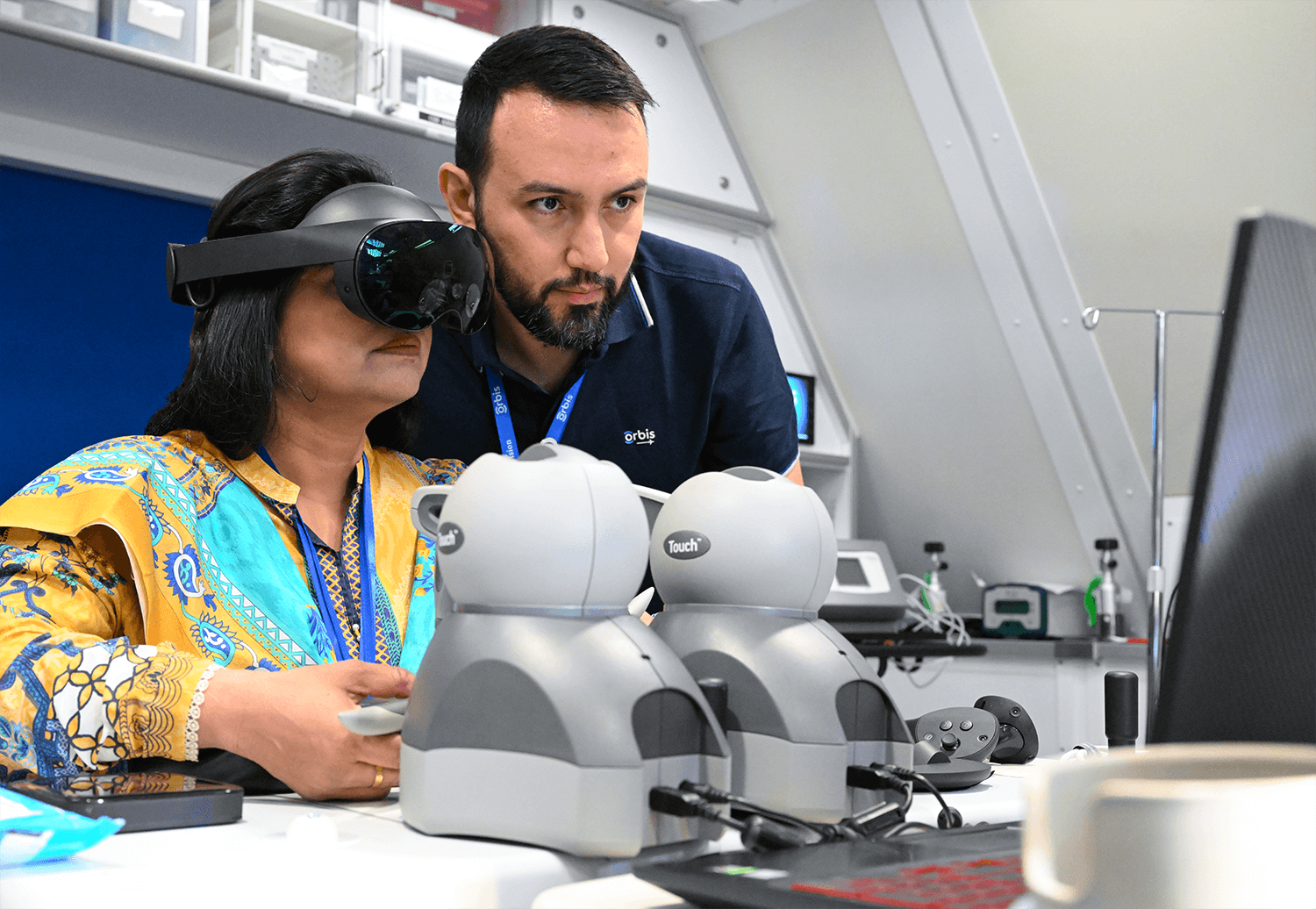
To support this mission, Orbis harnessed the power of immersive technology to create a virtual reality (VR) training tool to enhance training for novice surgeons. The initial development and launch were a complex process that required significantly more time than initially expected and multiple iterations to meet expectations.
Together the team quickly discovered that understanding user needs would be critical to successful deployment and future scaling.
A key breakthrough for the project was achieved when hospital-based training was introduced. By providing in-person training on the simulator, implementation needs were quickly identified and addressed. Champions for the solution were created, and users reported more confidence.
Orbis's emphasis on the end-user experience was key to simplifying the setup process and minimizing initial barriers for users. By actively listening and addressing user needs, we achieved notable improvements in user adoption and engagement.
Challenges
A major challenge was in achieving realistic haptic fidelity for the simulator. Ensuring the right value of feel and friction to properly mimic a real-life OR setting. Additionally, we encountered language barriers for global users.
Solution
- Working closely with the lead KOL to achieve a positive user on-boarding experience.
- Implementing a content management system to support localization in multiple languages was key to unlocking global accessibility.
Breakthroughs
Hospital-based training has provided on-site support that's crucial for gaining knowledge about implementation challenges and sharing success stories. This has allowed us to build stronger relationships with local teams, residency leads, and students.
UX insights
There is a learning curve associated with VR onboarding. But with in-person training, we've seen great improvement. Even novice surgeons, with VR practice, become independent very quickly, and patient outcomes have improved while trainer time in the operating room has reduced.
Future aspirations
There is a clear desire from partners for additional features and new simulations. The future will likely involve balancing the ambition to scale with the high cost of haptic development in a way that serves our mission and expands global programs.
Scaling a program across borders?
Localization, onboarding and in-person support are what turn a simulator into an adopted program. We build all three.
Related content
 Case studyOphthalmology
Democratizing ophthalmic knowledge
Physician leadership was critical to success as it would not only guarantee accuracy and educational integrity but also aid in adoption and scalability.
Read more White paperOphthalmology
Roadmap to success
The adoption of immersive solutions is not a single event, but instead a comprehensive journey.
14 min readRead more