
Prove your training is working. Not just that it happened.
Fundamental XR Insights turns every simulation session into evidence you can act on, and defend. Scoped to your institution, and tied to the business outcome you are actually accountable for.
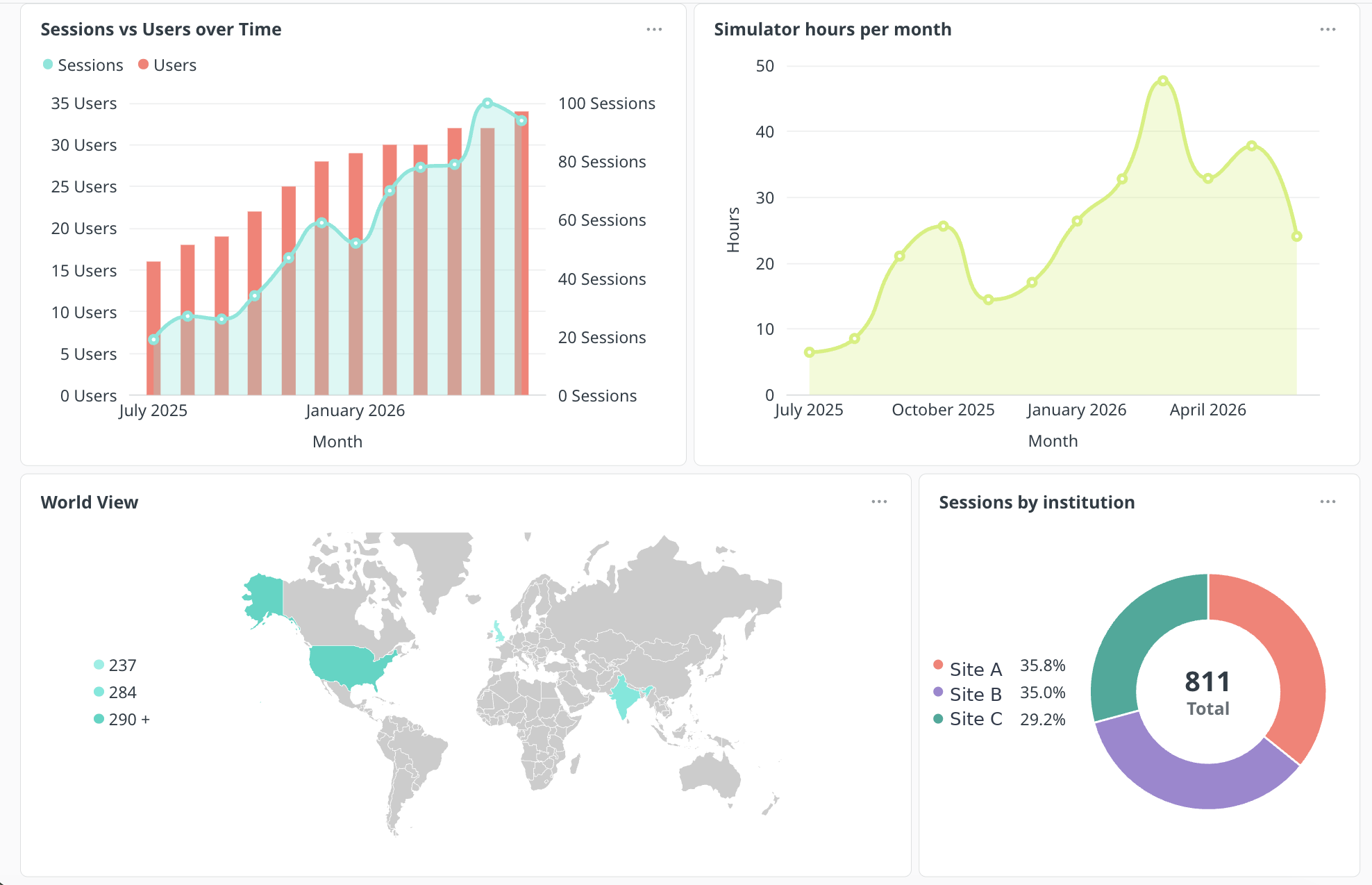
The patient outcome
Fewer complicationsSafer proceduresBetter recovery
Clients tell us procedures go more smoothly when their team trains on the right objectives. That's the outcome every metric below is chosen to serve.
We don't start with the simulation. We start with your outcome.
Most training reporting starts with whatever the simulation happens to log, then works backwards to find something worth reporting. We build in the opposite direction.
- 01
Your business outcome
Time to wet lab. Field escalations. Speed of product adoption. Whatever you're trying to move.
Field escalations. Down 40% target, first 90 days.
- 02
Your learning objectives
We help you define your learning objectives to best suit your business case and goals.
Capsulorhexis completed within tolerance, unassisted.
- 03
The metrics
The objectives set what gets measured. Each measure is co-built with your team and mapped to validated assessment frameworks.
Tear radius, force at rim, completion time.
- 04
The simulation
A realistic simulation built around the metrics, engineered to capture each one cleanly and repeatably.
Step 4, capsulorhexis. Haptic tolerance set to objective 3.
Questions you can answer after a session.
One session, different views: Whether the objective was met, how it was performed, who is training, and whether they know how good they are.
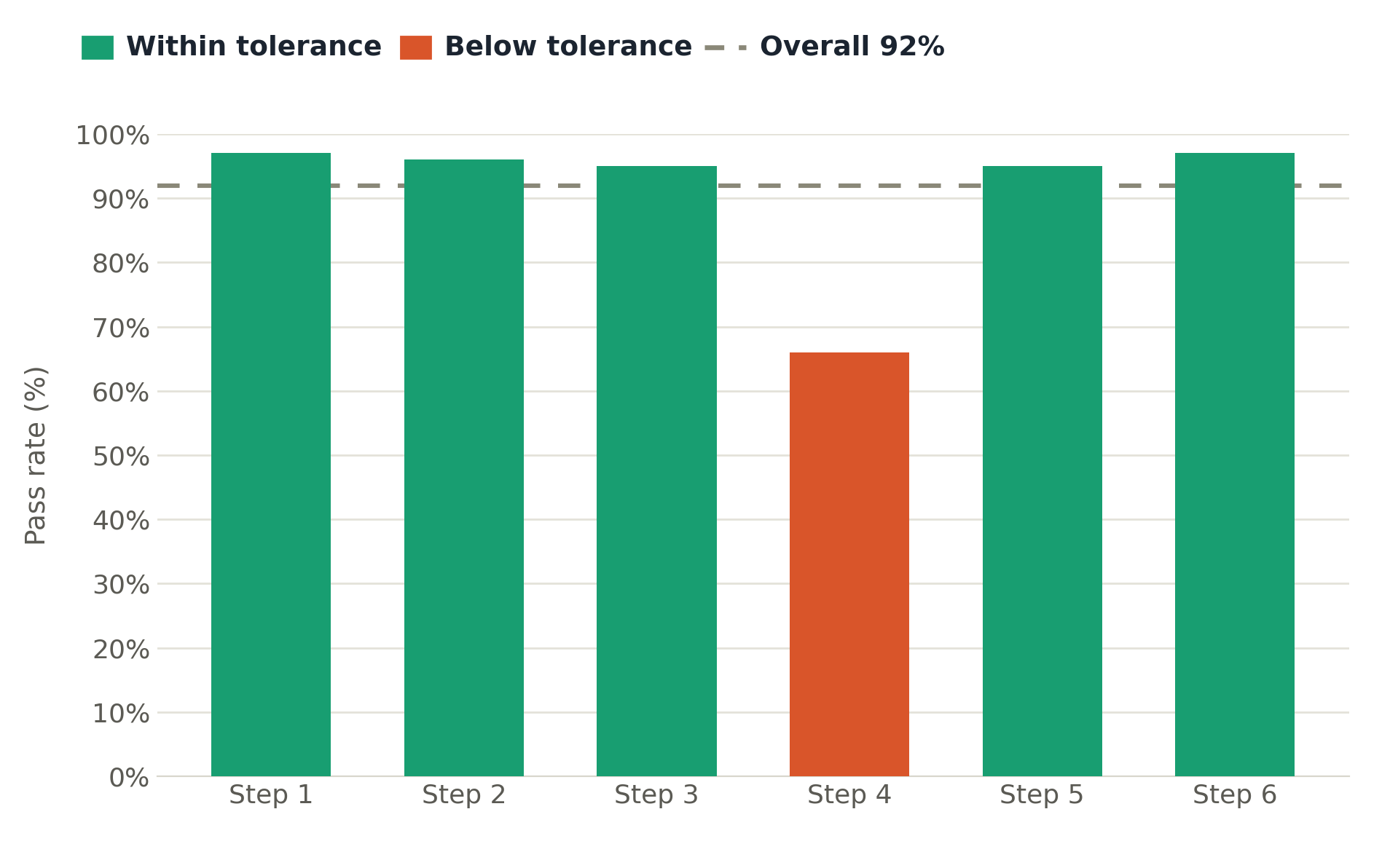
See if it's working.
Objective-level pass and fail rates, step by step, against tolerances built from validated assessment frameworks. You see which step is failing, not just that someone failed.
For tool-based simulations, that means force, angle, depth, position against tolerance; signals tied to the objective they were built to prove.
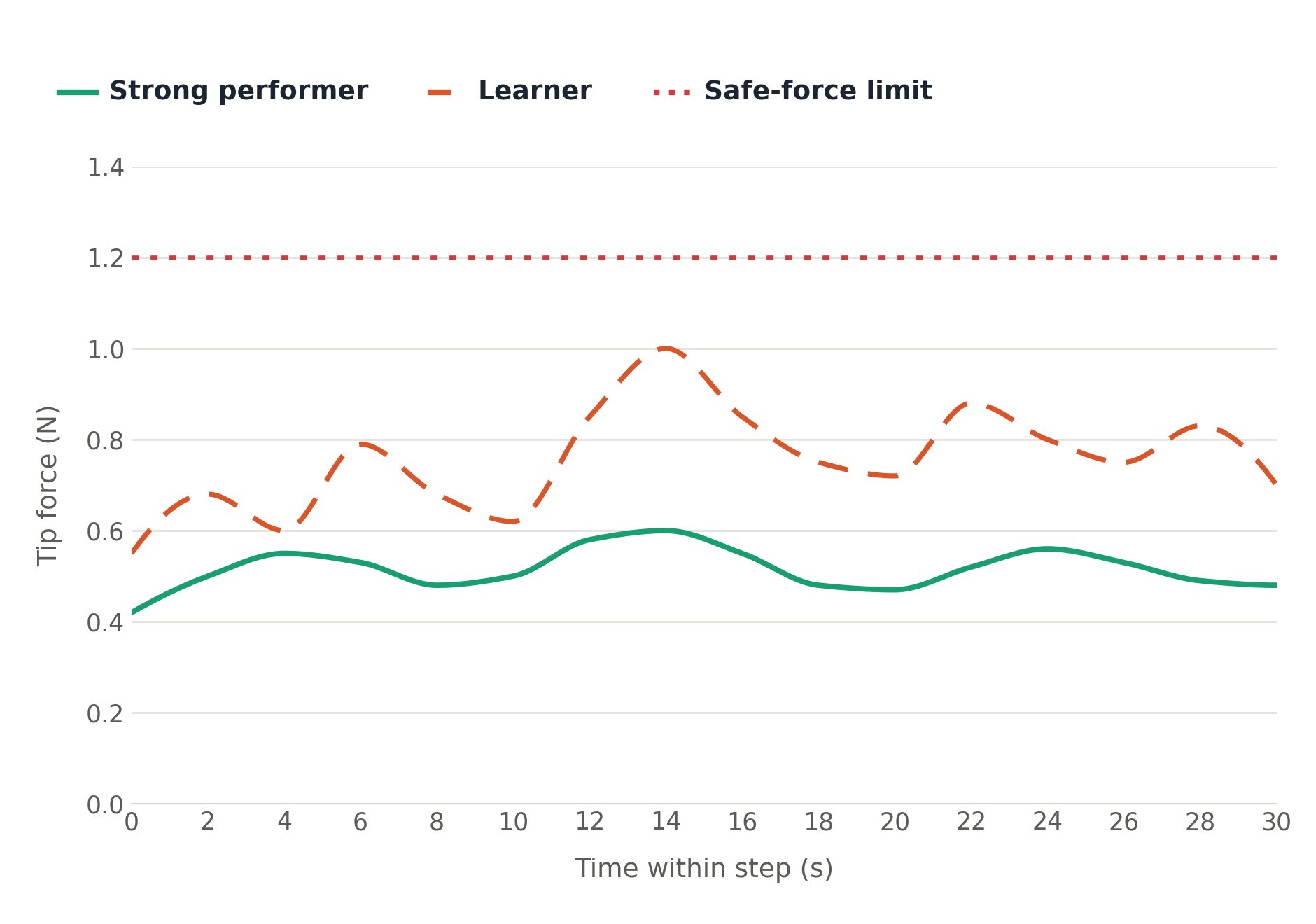
See how they're doing it.
Session replay mapped to the objective. Economy of movement, and how a learner's pattern compares to a strong performer.
| Learner | Site | Sessions |
|---|---|---|
| Learner 0481 | Site A · EU | 12 |
| Learner 0517 | Site A · EU | 3 |
| Learner 0602 | Site C · NA | 9 |
| Learner 0644 | Site C · NA | 1 |
| Learner 0723 | Site B · EU | 15 |
| Learner 0856 | Site A · EU | 7 |
See who's training.
Active learners, session volume, completion and time to competence, across every site, cohort and role. Filterable and exportable.
| Session | Self-reported | Objective |
|---|---|---|
| Session 1 · Step 2 | Moderate | Within tolerance |
| Session 1 · Step 4 | High | Below tolerance |
| Session 2 · Step 1 | Low | Within tolerance |
| Session 2 · Step 3 | Moderate | Within tolerance |
| Session 3 · Step 4 | High | Below tolerance |
| Session 4 · Step 2 | High | Within tolerance |
Confident, but not yet capable — intervene here.
See what they think.
Compare a learner's self-reported confidence against their actual performance in the same session. Catch that gap here, not in front of a patient.
- What did escalations cost us? field escalations The escalations your team handles in the first 90 days post-launch, measured against your own pre-launch baseline.
What did escalations cost us?
field escalations
The escalations your team handles in the first 90 days post-launch, measured against your own pre-launch baseline.
- When are they actually ready? time to readiness How many weeks earlier a cohort clears the wet-lab readiness bar.
When are they actually ready?
time to readiness
How many weeks earlier a cohort clears the wet-lab readiness bar.
- What did the reporting cost? reporting overhead The hours your team spends assembling programme reports each quarter.
What did the reporting cost?
reporting overhead
The hours your team spends assembling programme reports each quarter.
Sim session
Proctored case
Field escalation
Adverse event
Every failure caught in a simulation is a failure that never reached a patient. Insights moves detection as far left as possible.
Get to competence sooner.
See who's ready and who isn't before they reach a wet lab, a proctored case, or a live theatre. Simulation hours are the cheapest hours in your program, so you stop paying for the expensive ones twice.
Cut escalations before they happen.
Objective-level failure data shows which sites are drifting outside tolerance while it's still a training problem. Sending a specialist to a site on a Tuesday costs a fraction of sending one to a case that's already gone wrong.
Adopt faster, with less variance.
Track how quickly a new device moves from trained to consistently performed across a cohort. Adoption curves you can see are adoption curves you can shorten, and that timing shows up in revenue.
Defend the budget with evidence.
When finance asks what the program returned, you answer with objective outcomes traced to a business metric, not attendance figures.
It fits the systems you already run.
Your LMS stays the system of record.
Single sign-on through your existing identity provider, and completion and objective-level results write back to your LMS over xAPI, so a transcript reflects competence, not just attendance.
Your data, and real access to it.
Export any view to CSV or Excel, schedule reports to your team, or pull utilisation and outcome data straight into your own systems by API.
Robust and portable pipeline.
Capture through to query, on a pipeline that's ours and can be yours with xAPI.
Governed to institutional standards.
Data residency in your region, a signed DPA, SSO through your identity provider, and de-identification applied before any cross-account view.
Start with the number you have to defend.
Tell us the outcome you're trying to move and we'll show you the objectives, the metrics, and the simulation scope that get you there, in that order. Insights is included in every active Fundamental XR contract.